



Taferi Kela, Sidama, Ethiopia
The nursery at Taferi Kela houses hundreds of thousands of young plants. They grow shaded by simple wooden structures, about waist height, which are strung together with rope. As we first catch sight of the vast stretch of straw roofs, heads start to pop up from beneath them. Slowly at first, then accelerating as we get closer. By the time we have reached them our welcome party has fully emerged: the day’s entire staff, numbering some 50 people. Their work forms the foundations of Bette Buna, an Ethiopian coffee farm and export company founded by Hester and Dawit Syoum. I spent about a week with Hester during the 2026 harvest to learn about their work.
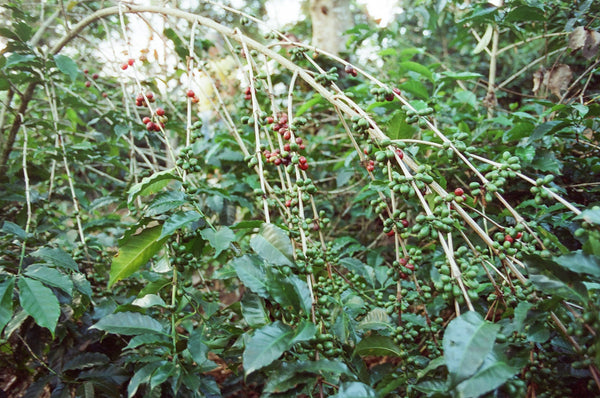
When Hester and Dawit agreed to take over their family’s coffee farm they were assuming responsibility for much more than just coffee. The people of Taferi Kela were looking to them for guidance, but the situation they inherited was extremely challenging. Economic scarcity meant that the land was severely neglected. Invasive eucalyptus trees crowded out the farm’s spindly, old coffee trees and very few farming practices were systematised. This was not just true of their own farm, but the farms of their neighbours, too. Safeguarding Taferi Kela’s future required a complete overhaul. This is easier said than done. In Ethiopia, many have an almost spiritual relationship to the trees they tend, making the adoption of common farming practices like stumping* hard to swallow. Hester and Dawit used their own farm as a living case study, intending to prove the merits of such practices to the wider community. They succeeded, but even so, it was not easy. As we walk through a plot of a variety called “74110”, Hester recounts their first stumping. "My auntie was distraught," she tells me. “She cried and cried over the fallen branches. It took a long time for us to build trust with the locals here. Many practices we tried to introduce were so alien to the people. It was difficult.”

Bette Buna’s nursery staff
Difficult, but necessary in a region where most can only afford to eat one meal per day. Today the Bette Buna farm at Taferi Kela has expanded (from 2 to 20 hectares) and employs over 100 full-time members of staff. The nursery supplies some 350,000 seedlings to local farmers per year, who may have them for free, provided they attend farming educational seminars. At the nursery, I meet a young farmer who has benefitted enormously from this work. Basha has his own farm in the area, where he enthusiastically employs the teachings he has picked up from the Bette Buna staff. His appetite for learning is insatiable. This is a system which feeds itself: by investing in local coffee cultivation, Bette Buna have more high-quality coffee to export, which in turn generates more funds for the nursery and creates more jobs. It’s a revitalizing and circular blueprint.
Having proven their methods on their own farm, Bette Buna have started to employ them elsewhere. A new focus is the regeneration of the grasslands which surrounds the local church — an important fixture in this Orthodox community. Its spire stands tall, visible from behind a grassy knoll. From its direction comes the sound of children singing. Their voices accompany a discussion around agricultural plans and cup profiles. We may be talking about coffee, but you are never far from the knowledge that Bette Buna is first and foremost, about people. We continue our way, treading carefully to avoid stepping on young coffee trees, barely shin-height. “This used to be a thriving forest” explains Hester, gesturing towards them. “It will be again,” she smiles. As I meet her gaze I can’t help but agree. I’m sure it will.
* A method of pruning older trees to a low stump to encourage new growth and higher productivity.