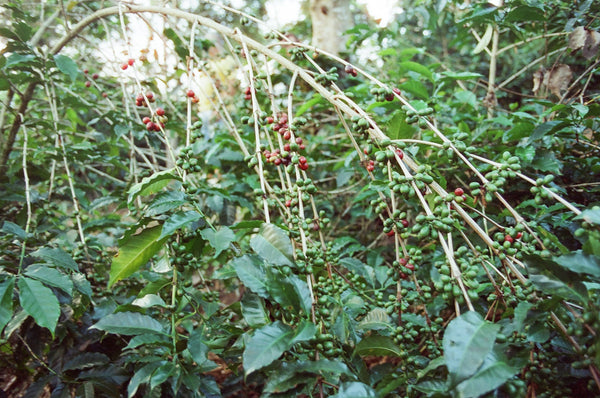




The village of Cotsilnam in the highlands of Chiapas was founded around 50 years ago. The very few Mayans in the area lived in the mountains, in parcels, surrounded by nothing but nature (and the traces of hundreds of years of colonialism.). Thanks to a bunch of coincidences, coffee was intentionally planted in those fertile soils and tropical forests. The crop found a nest, and the tsotsil group, led by seven families, began to live as a community.

Ana Santíz and Pedro Vasquez turning coffee cherries- each lot is represents of one day of harvest by the Tsotsil community of Aldama.
By 1994, the village had gotten a bit bigger. Coffees were now under the canopy of endemic trees; and the milpa system had been enriched by the presence of a fruit that offered something corn and beans and other crops could not: the possibility to start a conversation with the world beyond the mountains. On the 1st of January of `94, a social movement rose from those mountains: the EZLN (Ejército Zapatista de Liberación Nacional) set out to transform the destiny of the Mayan people in the Highlands of Chiapas.
I remember because I was 14 –years-old and San Cristóbal de Las Casas, the main city in the highlands, used to be a destination my family would visit: my father would run health campaigns in the villages surrounding San Cristóbal; and I always used to say: One day I will live here. The Zapatista movement gave me the dose of revolutionary fervor my adolescence needed. I clearly recall a saying from sub-comandante Marcos, their spiritual leader: To be seen, we covered our faces. They wore balaclavas and marched with wood rifles on the first morning of the new year.

A Zapatista billboard on display in the Tsotsil highlands.
The communion between Mayans, the highlands, the milpa, coffee, and zapatismo is an incredible story that in many ways has yet to be written. Somehow, coffee became the crop that complemented, or rather completed, the made-for-self-existence system of the milpa, opening a conversation with the world, in much the same way that zapatismo opened the world’s eyes so that the tsotsiles and tseltales in the highlands could be seen.

Left: Jesús shows us around his own farm in the Cerro Brujo.
Right: The Vasquez family of Cotsilnam.

The nursery on Jesús’ farm grows both seedlings for his own land as well as young plants which are distributed to smallholder farmers in the indigenous communities he works with.
Life in Cotsilnam became more “dynamic”, not only because zapatismo made some investments in the area possible: a road, electricity, a school, eventually telecommunications. It also caused political polarization. The situation remained complex for years. Coffee brought the silent solution.
I started to work in Cotsilnam in 2011 by accident. I was looking for partners to work with in the highlands, looking for survival at the very beginning of my coffee journey. I found my first real coffee-mentor in Cotsilnam. Fifteen years later, I can tell you that I now have many more, women and men who have taught me everything that matters about coffee farming. After all this time — during which a mestizo like me could earn the trust of the community — Cotsilnam became the main coffee origin for Cafeología. This is not because of the volume or the quality, which are both high. I never imagined having such deep roots in any place.

March 2025, travelling together with Jesús.